

Six weeks after we published a page setting out Express Writers’ current ownership facts, we ran two sets of checks: 3 web-enabled queries through consumer AI assistants and 5 model tests with browsing disabled. All 3 web-enabled answers had the current facts. None of the 5 browsing-disabled answers did.
The web-enabled answers could draw on newer sources, but the browsing-disabled answers still depended on what the models had learned during training.
When you assess your company’s AI visibility, treat those as separate results. One shows whether current information can reach an answer through the web. The other shows what the model can produce without web access.
That was the picture at six weeks in our own test. Another company or model setting may not show the same split by then.
In this article, I’ll show how we tested the change and what each signal can tell you.
How Often Is ChatGPT Updated?
When people ask, “How often does ChatGPT update its data?” they are often combining two different information paths. When ChatGPT uses search, it can draw on current web sources. In our browsing-disabled model tests, the answers had to rely on what the models learned during training.
The first is retrieval knowledge: information found in current sources while the answer is being produced. The second is parametric knowledge, the technical term for information represented in the trained model. I’ll use the plainer term “trained knowledge” from here.
LLM training data is the material used to train a model. It is not the same as the knowledge later represented in that model’s parameters.
That distinction changes what “updated” means in practice.
OpenAI explains how ChatGPT search works and its model pages list different knowledge cutoffs by model. A current answer with supporting web citations can show that newer information informed that response. But it cannot tell us whether the model had learned the same fact during training.
Publishing a new page does not add its facts to the LLM training data already used to train an existing model. Likewise, a product update does not necessarily change a model’s knowledge cutoff. Even a new model release does not prove that one specific company fact became part of its trained knowledge.
That is why we checked web-enabled and browsing-disabled answers separately.
How We Tested This on Our Own Site
Using our own site meant we knew which ownership details were current and exactly when the new information went live.
Our pre-publication checks gave us a baseline before the page went live: all five assistants came back with stale ownership-era framing and missed the current ownership details.
On the new Express Writers AI information page, we put the current facts in the visible copy and added Organization JSON-LD structured data. We also included a sentence written only for this test so we could look for the exact wording later.
We called that sentence a canary. If a later answer repeated it word for word, we would have a clearer signal that the page’s distinctive wording had carried into the answer.
Here’s how the six weeks unfolded:
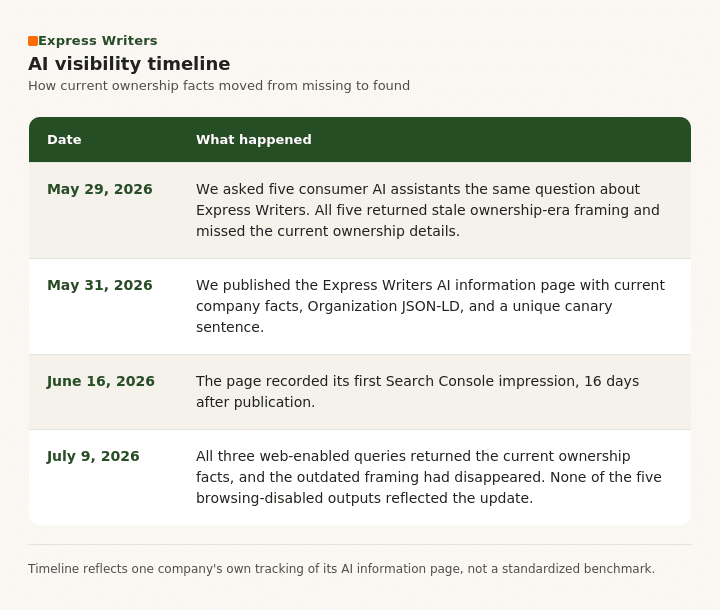
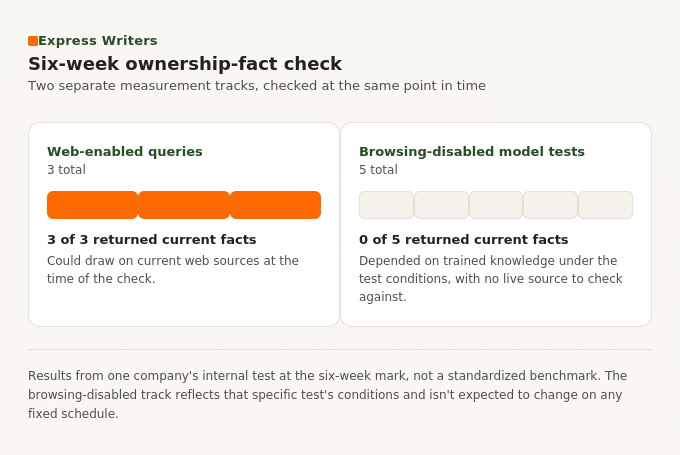
In July, the web-enabled answers cited the Express Writers AI information page alongside Crunchbase and LinkedIn. That placed our page inside a broader cited source mix, alongside other sources carrying the same current facts.
None of the answers repeated the canary sentence word for word. The citations did show that the page was part of the source mix, but not that any answer had used its distinctive wording.
“The noise around LLMs is endless. It’s still a new space, and it changes constantly. The uncertainty gives bad operators room to overpromise. I tell our clients there isn’t one fixed timeline for when a rebrand or corrected fact will show up in AI answers. The right tactics are tailored and depend on the brand. Don’t follow the latest LinkedIn post. Instead, focus on the fundamentals, then build on what your own results show.”
– Adam Oakley, CEO of Express Writers
What Search Console and the Crawler Data Showed
The AI checks gave us the starting point and the July result, but not how the page began appearing in search or what the crawler logs showed around the retest.
So we looked at Search Console impressions, compared Google’s latest crawl dates, and reviewed the Cloudflare data available from early July.
The Page Appeared in Search, but Visibility Stayed Low at First
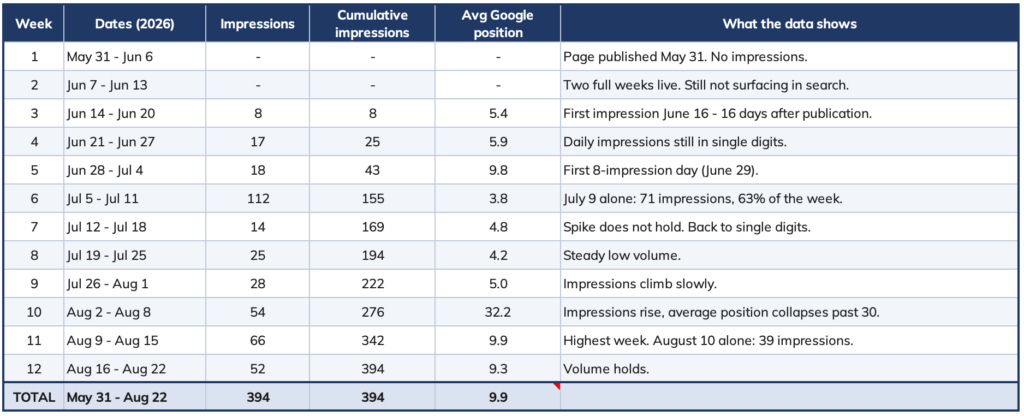
That first Search Console impression for the new AI information page arrived on June 16, 16 days after publication.
Daily impressions stayed in the single digits for about two weeks. They began to pick up during the week of June 29, with a clearer increase from July 7. In its first six weeks, the page recorded 155 impressions with an average position of 4.8.
Put plainly, when the page appeared in Google’s results, its reported position averaged about fifth. But with 155 impressions across six weeks, it was not showing up very often.
On July 13, we compared the latest crawl dates for three pages on our site:
- The homepage: Google crawled it that day.
- Another page on our website: Google crawled it eight days earlier.
- The new AI information page: Google last crawled it about 27 days earlier.
The newest page had gone the longest without a Google crawl. That was consistent with the slower start we saw in Search Console.
The Cloudflare Logs Showed More Than One Kind of Activity
We checked Cloudflare data available from July 5 through July 13, a recent snapshot rather than a historical series. Verified AI-related agents made about 4.5 times as many requests as Googlebot during that period.
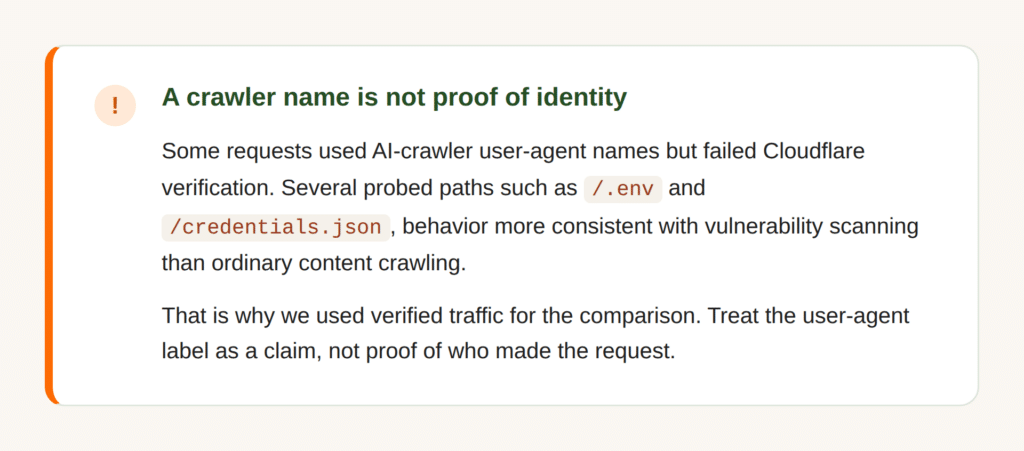
Verification solved one problem, but it did not make the agents equivalent.
For example, our logs included three OpenAI agents serving different functions:
- OAI-SearchBot supports ChatGPT search. Of the three OpenAI agents in our logs, it is the one tied most directly to that function.
- GPTBot crawls content that may be used for training. A GPTBot request does not show that a page was included in LLM training data.
- ChatGPT-User visits pages after certain user actions. It reflects a user-triggered visit, not automatic crawling.
The 4.5x figure combined requests from agents serving different purposes, so it could not tell us whether any recorded request contributed to the July web-enabled answers.
What GA4 Showed Us
The crawler logs showed us the requests. To see what happened when people clicked through to the site, we checked GA4.
In its first six weeks, the new AI information page received three sessions. None was attributed to an AI assistant.
Across the site, traffic attributed to AI assistant interfaces was also small compared with organic search.
From February 1 through July 12, GA4 attributed 180 sessions to direct clicks from AI assistant interfaces, compared with 24,580 sessions from organic search. That put traffic from AI-assistant interfaces at about 0.7% of the organic search total for that same period.
At both the page and site level, we could attribute a session to an assistant when someone clicked through, and enough referral information remained to identify the source. But a web-enabled answer could cite the page or include the current facts without sending anyone to the site. Without a click, GA4 had no landing-page session to record.
That is why you would track the session count beside the answer checks rather than use one in place of the other. Sessions show attributable visits. The checks show whether the current facts surfaced, even when no one clicked through.
What This Changes About How You Measure AI Visibility
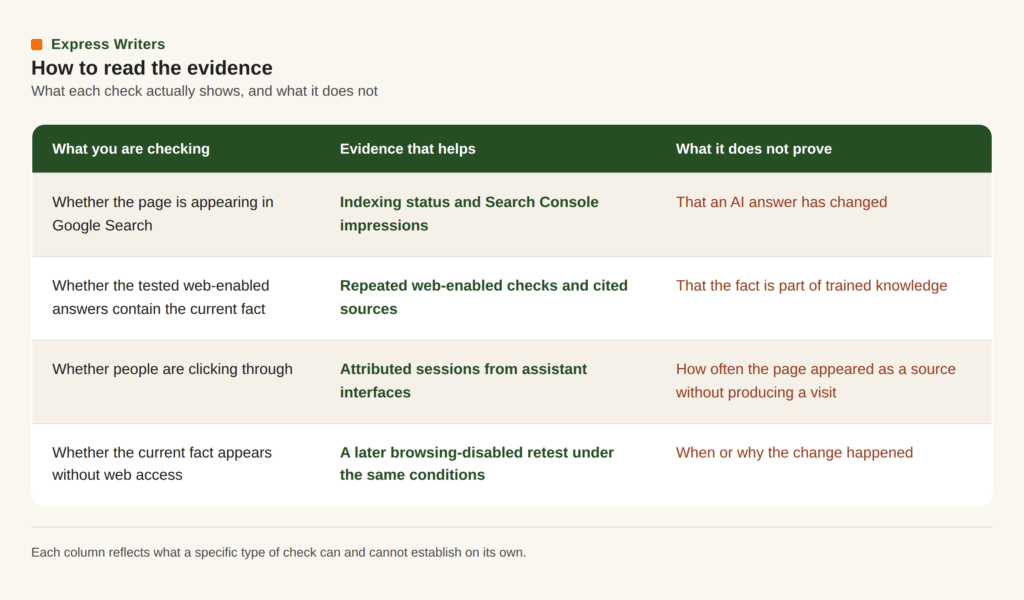
Start with the question you need to answer, then choose evidence that can answer it. Don’t make one signal do two different jobs:
Why Search Visibility Belongs Beside AI Visibility Metrics
In July, Semrush gave Express Writers and a national manufacturing brand we work with the same AI Visibility Score: 17. But the matching scores did not mean the brands had the same number of mentions.
The score compares a brand’s presence in AI answers with its competitors. The mention count shows how many tracked prompts produced responses that mentioned the brand.
The manufacturing brand had 621 mentions, compared with 53 for Express Writers. It also had much stronger Google visibility for its commercial searches. In this comparison, the brand with stronger Google visibility also had far more AI mentions.
Read the score beside the mention count and the brand’s Google visibility. The score adds competitive context, while the mention count shows observed volume. Google visibility helps show how discoverable the brand already is in search.
The comparison does not prove that Google visibility caused the difference in AI mentions. It does provide a reason to examine the two together.
What to Do When AI Answers Still Have the Wrong Company Facts
“Brands need accurate information across multiple external sources. Relying only on your own site is not enough. Identify the places where customers encounter your brand, then make sure what they find there is up to date. That takes time, but it helps reduce conflicting information online.”
– Adam Oakley, CEO of Express Writers
When stale facts keep surfacing, your AI search optimization work should begin with the sources you control, then move outward. Keep each retest as comparable as possible so you can see how the answer changed:
- Put the current fact on a page you maintain. State it plainly enough that another source could repeat it accurately. Link to the page from relevant parts of your website. If you use structured data, make sure it accurately reflects the visible copy.
- Review the public profiles and sources you can update. In our July checks, the web-enabled answers cited the Express Writers page alongside Crunchbase and LinkedIn. That source mix is a reason to review credible public profiles that should carry the same fact. Update the profiles you can edit and request corrections where appropriate.
- Repeat the web-enabled check. Use the same question and keep search available. Save the full result, including its citations and date, so you can compare it with the earlier check.
- Run a later browsing-disabled check if you need to know whether the fact appears without web access. Use the same question and keep browsing disabled, but record which model or version produced the answer. Compare that result with the earlier browsing-disabled check. That can show what the model produced without web access at that point. But it cannot tell you exactly when the change happened or what caused it.
What We’re Checking Next
Our July 9 retest still left two questions open. The five browsing-disabled outputs still reflected the old facts, and no answer had repeated the canary sentence word for word.
We plan to check both again around Q4 2026.
Frequently Asked Questions
How Often Is ChatGPT Updated with New Information About My Company?
ChatGPT does not follow one update schedule. Timing depends on whether an answer can use current web sources or has to rely on trained knowledge.
Across the assistants we tested, all three web-enabled checks returned the current facts when we checked again at six weeks.
All five browsing-disabled checks still had the old information.
What Is the Difference Between Retrieval and Parametric Knowledge?
Retrieval uses available sources while an answer is being produced. Parametric knowledge is information represented in the trained model itself. In this article, I use “trained knowledge” as the plainer term for parametric knowledge.
Why Does ChatGPT Still Show Outdated Information About My Brand?
One answer may rely on trained knowledge that predates your correction. Another may search the web and find newer sources. Outdated public profiles can also leave conflicting information available to search-enabled systems.
Check whether the answer used search and which sources it cited.
Why Don’t AI Citations Show Up as Traffic in My Analytics?
A citation does not always lead to a click. An AI answer can cite a page or include its facts without sending anyone to the site.
GA4 can attribute a session to an AI assistant when someone clicks through and enough referral information remains to identify the source.
When Old Company Information Keeps Appearing
Bring the stale answer, the sources it cites, and the current fact you need reflected. Express Writers can help you trace where the old information is coming from, then decide what the evidence supports changing and checking next. This is part of our GEO and AEO services.
Schedule a consultation to talk through what you are seeing and whether we are the right team to help.