What Are Content Marketing Services?
Content marketing services are the work a brand outsources to plan, write, and optimize the content that earns its audience — blog posts and articles, SEO content, website copy, email, social posts, and the strategy behind them. Some agencies run entire campaigns; others, like Express Writers, focus on writing the content itself with a senior in-house team and published per-word pricing, which keeps the service easy to compare and budget. The nine services below cover what a complete content marketing engagement includes and when each one matters.
Content marketing is no longer optional for any brand that wants to grow.
Consider this: 84% of consumers expect brands to create content.
And if you think you can just get in front of them with ads… think again.
Most people skip right past the paid results and click the organic listings instead. Organic is where you’ll win.
If you’re weighing content marketing services, it can be overwhelming to figure out what to choose and from whom. (One note up front: we focus on writing the content itself rather than running your campaign end to end, so this guide is built to help whichever route you take.) Should you go with strategic content services from a digital marketing agency? Content development from a creative agency?
Or should you just go renegade and do it all yourself?
You have a lot of options, so I’ve put together this guide to the content marketing services that actually matter. It has advice for whichever route you choose, so if you’re going to take the dive (and you should), start here.

So, Exactly What Does Content Marketing Entail?
If you asked me to pick the top buzzwords in the online writing industry, content marketing would be near the top of the list.
It’s hard to say exactly when the term content marketing first appeared. It shows up in a few marketing textbooks (available on Google Books) from the late 1990s, but most sources indicate that digital marketers adopted the term in the mid-2000s.
Now it’s everywhere. But what does it mean?
In short, content marketing is the strategic planning, creation, and distribution of content to reach audiences and drive revenue. (CMI wrote a thorough guide on it that’s worth reading.)
Today, content marketing is all but a necessity for any company looking to market itself effectively. Consumers grew tired of in-your-face advertising and pushy sales tactics a long time ago.
Content marketing takes a different approach. It emphasizes delivering helpful, useful content to audiences rather than pressuring them to buy.
It helps to think of content marketing as a chain reaction. Each step builds on the previous one to create a working system that builds an audience and generates leads. In general, you’ll see six steps:
- Strategy: Content strategy is the foundation of content marketing. It’s your road map and blueprint to build your content engine.
- Creation: Content marketing relies on creating strong content developed with your audience’s needs and the customer journey in mind.
- Optimization: With optimization, it’s time to get technical. Here, you make sure search engines see you, your site works on mobile, and the details are right.
- Distribution: Also called promotion in some resources, this is the release of your content on platforms like your blog or social media.
- Maintenance: Keeping the momentum going matters. In the maintenance stage, you apply the sensibilities of marketing to keep your content and presence fresh.
- Metrics: Today, everything is data-driven. To maximize success, you need to know how your content is performing.
Content marketing involves a lot. It’s no surprise that many companies outsource at least one of those elements, usually content creation, even when they have an in-house team.
So what all goes into content marketing? Here are nine content marketing services worth considering if you want to grow your brand.
9 Content Marketing Services You Need to Grow Your Brand
You’ve got abundant options for content marketing services and packages. As the approach has gone mainstream, there’s no shortage of agencies and independents offering tools, tricks, and services.
But not all content marketing services are created equal. It takes a discerning eye to decide which option is best for you.
If you’re looking around and feeling overwhelmed, I get it. It’s a big world.
Here’s a guide to the top nine services for content development and marketing that are worth your consideration.
1. A Documented Content Strategy
First and foremost, don’t go anywhere without a road map. Content strategy is the framework for your content marketing. It’s what informs decisions like what content you create and where you distribute it.
In many ways, developing your content strategy is front-loading your content marketing. With a solid strategy as your foundation, you’re already halfway to a comprehensive content marketing engine.
Strongly consider documenting your overarching strategy. According to CMI’s 2026 B2B research, 97% of marketers now have a content strategy, and 61% say theirs improved over the past year, most often by refining the strategy itself (74%). A clear, documented plan is what separates the teams that keep improving from the ones that stall.
Many marketing agencies and even freelance writers offer content strategy. When shopping for a service, make sure it includes a few essentials:
- Trending topics research: Don’t let your content strategist rely on what’s already on your site. A good one takes the initiative by researching topics in your industry.
- SEO and keyword research: SEO remains a backbone of content development, even as the emphasis lies on delivering exceptional content.
- Brand awareness: At the end of the day, content strategy is still about promoting your brand. Choose a strategist who can reflect this in the content plan and creation.
- Content planning: A list of titles and some keywords isn’t enough. Look for strategic content services that deliver a comprehensive plan for creating, publishing, and maintaining your content (like using an editorial calendar).
2. Genuinely Authoritative Content
You can have the best strategy and the best delivery, but if your content falls flat, none of it matters.
What does strong content look like today? It’s:
- Authoritative: You know what you’re talking about, and it shows.
- Results-driven: Either moving a reader along the customer journey or solving a problem for them (no strings attached).
- Genuinely well done: It’s well-written, well-designed, and worth a reader’s time.
This is where your chosen agency’s portfolio and website come in handy. It’s smart to work with one agency (or team) to centralize your content marketing. (Among the most effective B2B teams, CMI found 65% credit content relevance and quality, and 53% credit their team’s skills and capabilities.)
That agency likely already has writers or other content creators on hand. One advantage of this route is that those creators are already vetted and will deliver quality.
Of course, if you’re building your internal team, the same advice applies. Look through the individual’s portfolio and see if their work is authoritative, results-driven, and genuinely well done.
One word of warning: you get what you pay for with content writing. While it might be tempting to go for cheap services or packages, content marketing is a skill that often commands a premium. The smart move is to hire the quality content agency the first time around.
Pro Tip: Do You Have a Blog? You Need One.
Spend enough time online and you’ll come across all sorts of novel content ideas. But none has remained as much of a staple as blogging.
The first blog was created in 1994. Decades later, blogs remain one of the top ways readers access information. Yet blogging is still routinely underestimated, and that’s a mistake that can cost you.
According to CMI, owned media like your website and blog remains one of the top areas B2B marketers plan to invest in. And HubSpot has found that marketers who prioritize blogging are far more likely to see a positive ROI.
Do you have a blog full of authoritative, well-researched, in-depth posts? If not, you need to get on that.
3. Frank, Thoughtful Video Creation
One of the biggest content marketing trends in recent years is video, and I’m not the only one saying it.
According to HubSpot, a majority of consumers want more video content. According to OptinMonster, video generates two-thirds more qualified leads than other forms of media.
But it’s not enough to simply create good video content. Sure, it’s easier to consume, especially on the go. Video became popular as a branding tool for another reason entirely:
Audiences perceive video content as an authentic, raw glimpse into a brand.
Pictures can be doctored. Statistics can be manipulated. Anyone can say anything on the web.
Video, on the other hand, carries the natural perception that it’s real. According to Convince and Convert, at least 40% of viewers regard video as more credible than other forms of content, even when they’re obviously ads. When building brand authenticity is crucial to success, that’s too valuable to pass up.
Think about how your brand incorporates video. You want it.
4. Infographics & Visual Assets
Infographics work. They’re one of the most effective formats out there because they tap into our natural curiosity, especially if you’re a data junkie like me.
Although video has become the new darling of the content world, visual assets still play a major role in content marketing.
According to Demand Gen Report, infographics not only increase traffic to a site by 12% but also help significantly with information retention.
Although great copy absolutely matters, visuals have a few advantages text doesn’t:
- Most people (65%) are visual learners, and infographics cater to them.
- Infographics are easier to share on social media (which might be why they increase traffic).
- They can deliver a lot of information very quickly.
- Through careful design, color, and content curation, they can reinforce branding.
Infographics work. Use them.
(Want to take it up a notch? Use infographic videos.)

One of the world’s first infographics. It was published in 1821 and depicts the history of wheat prices. It even came in color. Source: Gizmodo.
5. A Solid WordPress Site
Did you know WordPress powers 41.5% of the web? There’s a good reason for that.
WordPress has everything you need to launch a full professional web presence quickly.
But how does having a WordPress site relate to content marketing? Simple. At a minimum, to support your content marketing efforts, you need:
- A blog.
- Landing pages.
- Static pages with thoughtful copy for products or services.
- A contact form or e-commerce site to funnel all those warm leads.
WordPress makes setting up each of those easy. It’s also flexible: you can support content marketing with:
- Membership portals and communities.
- Comments and discussions on your blog posts (great for conversational marketing).
- Integration with social media accounts.
- Advanced SEO tools and metrics plugins.
Most guides about content marketing emphasize the planning, creation, and distribution of content. I’d add that there’s an infrastructural element to content marketing, too.
You need a great business website.
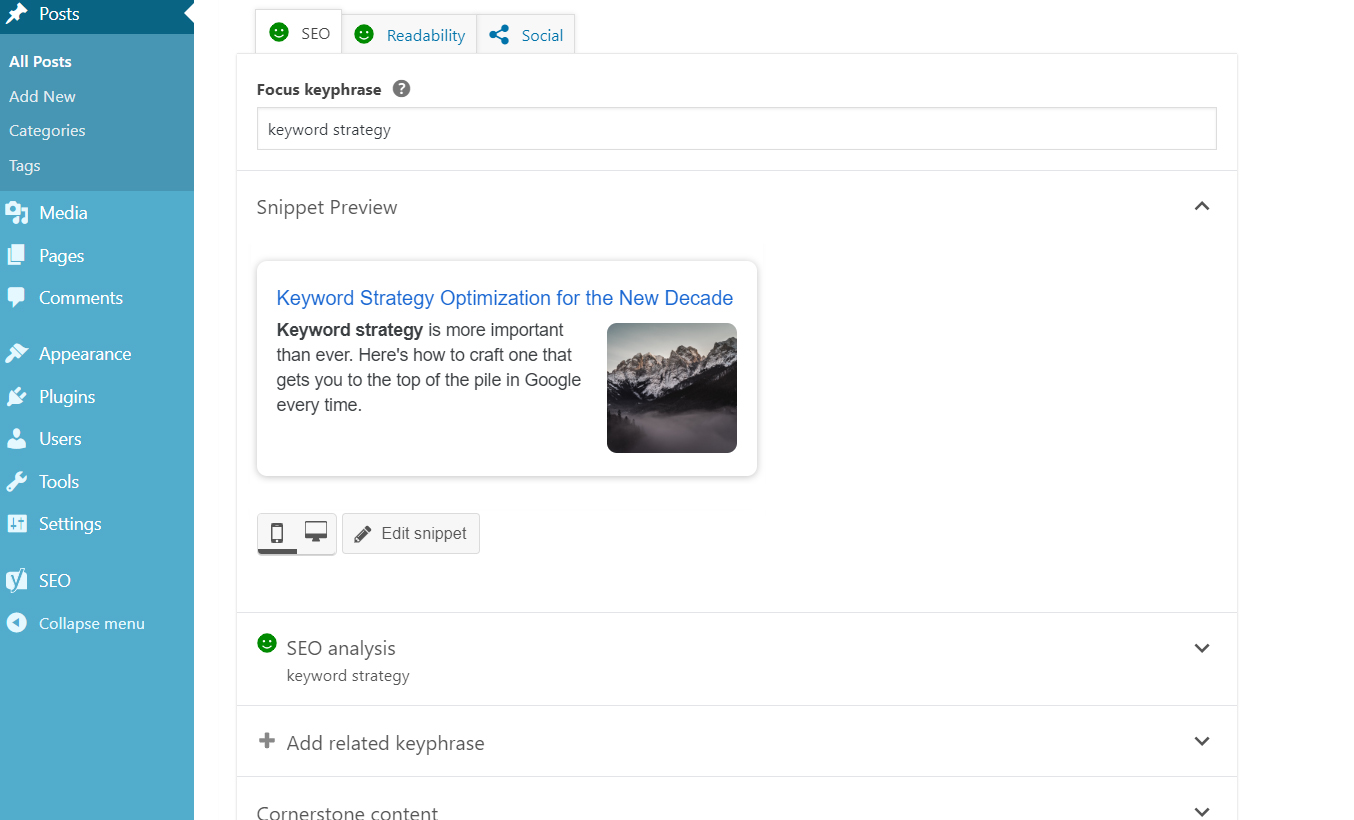
WordPress has many powerful tools, like Yoast SEO, that can support your content marketing efforts.
6. On-Brand Social Media
Does your business have a social media account? If you’re like most businesses, you’ve got somewhere between four and 10 of them (according to Hootsuite).
Social media remains a top channel for content marketers, and that’s not changing. For most businesses, it’s an essential part of how they distribute content and stay visible.
If you’ve been struggling to keep up with social media, it’s time to get on that. There are two things you can do:
- Concentrate your social media presence: It’s better to consistently distribute content on a couple of platforms than to post sporadically on several. Close those unused accounts.
- Bring a dedicated social media manager on board: Someone on your content marketing team should manage social media. Or the agency you select should offer management packages.
Need a refresher on how to run social media well? Check out this guide.
7. Disciplined Email Marketing
It seems like blogging’s been around forever, but email has been around far longer (1971).
It’s still a valuable distribution channel that isn’t going away. Email remains one of the top owned-media channels marketers invest in, according to CMI. When done right, email marketing has an ROI of $44 for every dollar spent.
Definitely include email marketing in your content marketing, but be smart about it. I recommend the 3:1 Rule, which I consider a golden ratio of email marketing:
For every sales-focused email, send three value-focused emails first.
What are value-focused emails? They provide your readers with informative, useful content WITHOUT pitching sales.
Whether that means exclusive resources like white papers and ebooks, or links to your latest (or best) articles, view email marketing as another way to deliver value to your readers.
Remember, 91% of customers want to receive emails from brands they like. So get started leveraging that to build a rich conversation with them about your brand.
8. A Fresh, Modern Maintenance Routine
Content marketing relies on consistently providing fresh, useful content to readers. Many people assume this means unique, new content that hasn’t been posted yet.
That isn’t always true.
Having stale, outdated, or worse, inaccurate content on your site can hurt you more than having no content at all. One of the things Google looks at when determining rank is timeliness.
Content maintenance is therefore an important element of content marketing. It’s the process of going through a site and identifying:
- Poorly performing content: These pieces need to be updated or removed.
- Old, outdated content: Maybe something was accurate once and times (or tech) have changed. Update these pieces or remove them.
- Content hit by an algorithm update: Many people saw this with updates like Google BERT, which changed how search engines interpreted certain keywords and caused some businesses to drop in rank as their content became less relevant.
- Content that once performed well but no longer does: Since timeliness matters, refreshing these pages can return them to their former glory.
- Content that’s no longer relevant to the company: Brands pivot all the time. Don’t muddle a rebrand by retaining a semblance of your old identity.
Google loves fresh content, but that content doesn’t need to be totally unique. Perform content maintenance on a regular schedule and keep your entire site fresh.
9. The Right Tools to Measure Success
Finally, CMI’s 2026 research points to something the top content marketing performers do that lower-performing brands don’t: they measure.
In fact, difficulty measuring effectiveness is one of the biggest challenges marketers report (33%), and the most effective teams are the ones investing in the right technology and tools (43%) to track what’s working.
The takeaway is obvious: use metrics.
Which metrics? That depends. Everyone tracks ROI, conversion rates, and page views. But that might not always be right for you.
For example, if your pages typically contain in-depth, long-form content, consider tracking scroll depth.
Likewise, if you’re pursuing a conversational marketing approach, track things like comments, conversations with your chatbots, and backlinks.
There’s a whole world of content marketing metrics, KPIs, and tools out there. Follow the lead of the successful and implement them.
Build a Strong Content Marketing Plan With Express Writers
That was a lot. Hopefully this list of content marketing services has left you a little more inspired by the possibilities within your reach.
Your next step is to figure out how you’ll secure these services. Marketing agency? Internal team? DIY?
How about a senior content team with vetted expert writers already in place? When you partner with Express Writers, we make content strategy (and marketing) easier, with beautifully designed content written by expert copywriters.
Don’t wait. Schedule a consultation and get started on your best content marketing plan yet.